EIT RawMaterials Projects

The ambitious vision of EIT RawMaterials is realised by the creation of a structured collaboration within the Knowledge Triangle, which is the basis of the EIT model.

Call for Innovation & Education Projects is now open!

Learn more

EIT RawMaterials Projects Timeline

392 Projects
Project Portfolio
Innovation Themes
Innovation Areas/Lighthouses

Mineral Processing/Resource Efficiency

RoStar: Upscaling of the RoStar ultra fine grinding mill for liberation of high valued ores
Project duration: 1 April 2016 – 31 December 2018

Objective

The objective of the project is the creation of a pilot ultra-fine grinding mill by up-scaling and improvement of an existing demonstrator mill.

The solution (technology)

The mill will be a vertical fine grinding mill, where gravity forces enable a higher filling level than in horizontal mills and a hydraulic pressure on the grinding beads. Deliverables of the project will be a containerised pilot plant, a fine milling process with very low energy consumption.

Partnership

  • Technische Universität Bergakademie Freiberg (TUBAF), Germany (Lead Partner)
  • Agencia Estatal Consejo Superior de Investigaciones Cientificas, CSIC (Spanish National Research Council), Spain
  • Assarel Medet, Bulgaria
  • CEMTEC, Austria
  • Maelgwyn Mineral Services Limited, United Kingdom
  • Sandvik AB, Sweden
  • Sandvik SRP AB, Sweden
  • Université de Liège, Belgium
Recycling

RUN. Key success factors for ReUse Networks

Project status: Completed.

Objective

The role of reuse and preparation for reuse in a circular economy has been significantly strengthened by the five-step waste hierarchy that now clearly states that reusing ore remanufacturing of products should be preferable over all kinds of recycling. Nevertheless, there are still a variety of relevant barriers and uncertainties for reuse and related innovative business models. Therefore, RUN focuses on the development of entrepreneurial support services that are tailor-made for the needs of the reuse and remanufacturing sector. In this way, it aims to contribute to a reduced demand for raw materials in Europe. More precisely, the project identifies and address specific needs of reuse and remanufacturing community, inter alia missing platforms to exchange experiences and relevant information on key success factors for reuse networks. Thereby and based on other ongoing activities of the consortium, this project has the potential to establish a reuse network within the EIT RawMaterials.

The solution (technology)

The development of entrepreneurial support services will be achieved through:

  • mapping of relevant stakeholders and setting-up of an institutional framework for cooperation in order to bring together expertise from fields of reuse and remanufacturing,
  • identification of best practice and and key barriers for innovative SMEs in the sector,
  • analysis of raw material savings for different reuse and remanufacturing approaches and priorisation of activities from a raw material perspective.

The targeted end customers of this project are followings groups, which are already today in close collaboration with the partners of the EIT RawMaterials consortium: local entrepreneurs, intrapreneurs in municipal and private organisations, existing SMEs, students and spin-offs.

Partnership

  • Wuppertal Institut fuer Klima, Umwelt, Energie GmbH (Wuppertal Institute), Germany (Lead Partner)
  • Technische Universiteit Delft (Delft University of Technology), the Netherlands
  • Teknologian tutkimuskeskus VTT (Technical Research Centre of Finland Ltd. VTT), Finland
  • Wiederverwendungs- und Reparaturzentren in Deutschland, Germany
Substitution

SAFE-VULCA: Safer reduction of ZnO amount in rubber vulcanization process

Project duration: 1 January 2019 – 31 December 2021

Objective

Vulcanization is a consolidated process of the tire industry to improve the mechanical properties of rubber. In this context, ZnO is the most efficient curing activator worldwide employed to enhance and control its reaction rate. However, ZnO entails non-negligible potential environmental risks: according to the Environmental Protection Agency (EPA) zinc ion can become available from zinc oxide through several mechanisms and zinc ion can reasonably be anticipated to be toxic to aquatic organisms. As such, the reduction of ZnO level in rubber is becoming an urgent issue in rubber production and particularly tire manufacturing. Moreover, the presence of large amount of ZnO is also a drawback in the end-of-life tire recycling treatments.

The solution (technology)

The present project aims at reducing the amount of the traditional microcrystalline ZnO activator and at improving the efficiency of the curing process simultaneously, by replacing it with a novel activator ZnO-NP@SiO2-NP, constituted by ZnO nanoparticles anchored to silica, a common filler utilized in rubber composites for tires. The novel ZnO-NP@SiO2-NP behaves at the same time as curing agent and rubber reinforcing filler. It is synthesized by an easy-scalable and green sol-gel procedure, which has already been validated for the successful production of rubber composites with high mechanical performances emp ZnO-NP@SiO2-NP employed in common tires. Preliminary safety assessment also showed that ZnO-NP@SiO2-NP has lower toxicity than microcrystalline ZnO.
The substitution of the ZnO crystalline activator with ZnO-NP@SiO2-NP results in a remarkable curing efficiency, due to the high capability of the distributed zinc centres to react with the curatives in the rubber matrix during the vulcanization. This allows a reduction of around 50 % in the conventional amount of ZnO and enables to produce rubber composites for tire applications with curing and mechanical properties up to 10% better than those obtained with the traditional activator.

Partnership

  • Università degli Studi di Milano – Bicocca (University of Milano- Bicocca), Italy (Lead Partner)
  • Commissariat à l’énergie atomique et aux énergies alternatives, CEA (French Alternative Energies and Atomic Energy Commission), France
  • Fraunhofer-Gesellschaft zur Förderung der angewandten Forschung e.V. (Fraunhofer), Germany
  • Monolithos Ltd, Greece
  • Pirelli Tyre S.p.A, Italy
  • Stichting Katholieke Universiteit (Radboud University Nijmegen), Netherlands
Sustainable Mining

SAFEME4MINE: Preventive Maintenance system on safety devices of Mining Machinery

Project duration: 1 January 2020 – 31 December 2021

Objective

Mining machinery is strategic for mining and critical in terms of occupational health of the workers. SAFEME4MINE is a preventive maintenance system of mining machinery focused on safety devices. The project will develop a system (software-based solution and a measurement toolkit). Together with a precise inspection procedure, the system will give as result recommendations and corrective measures contributing to the overall maintenance strategy.

The solution (technology)

SAFEME4MINE project is born to answer the needs of mine safety, thanks to the development and implementation of an innovative maintenance system on safety devices of mining machinery that will enable mining operation with superior safety performance. SAFEME4MINE will develop an innovative integrated system consisting on a platform that combines cloud, edge and IoT technologies to collect, process and report data about the safety devices of mining machinery and includes a tool-kit to be used by supervisors and technician during the inspection phases to identify most critical elements to be inspected and to report results of on-field verifications.

This is a challenge to overcome because nowadays preventive maintenance strategies of this type of machinery do not consider worker integrity, although it is affecting the production and the efficiency of resources invested. Current maintenance programmes just test the functional conditions of the machinery, not taking into account employee safety.

Partnership

  • Epiroc Drilling Tools AB, Sweden
  • Bruno Kessler Institute, Italy
  • Hub Innovazione Trentino – Fondazione (HIT), Italy
  • Magnesitas Navarras S.A., Spain
  • Mine Master Sp. z o.o., Poland
  • Wroclaw University of Science and Technology (WUST), Poland
  • Tallinn University of Technology, Estonia
  • Technische Universität Bergakademie Freiberg (TUBAF), Germany
  • Technical University of Madrid (Lead Partner), Spain

SafeDeepMining: Continued education programme in rock engineering for deep mines

Project duration: 1 January 2018 – 31 March 2021

Objective

The objective of the programme is to educate mining engineers, authority staff and personnel in consulting and at universities in state-of-the art rock engineering to assist the European mining industry in dealing with rock pressure problems which threaten their future underground operations. The programme addresses the acute shortage of rock engineers. The two year programme is a joint initiative of mining universities and industry in Europe and overseas. Visit the project website for full details.

The solution (technology)

The European Association of Mining Industries, Metal Ores & Industrial Minerals (EUROMINES) lists in March 2017 “stability in greater depths of mines” as one of the major technical challenges (www.euromines.org). Deep mining is typically mining more than 1000 meters below surface although there is no clear border for definition.

The continuing education program “Rock engineering for deep mines” addresses the shortage of rock engineering personnel in the European mining industry. It provides mining and civil engineering graduates and geologists working in industry with the knowledge and tools to solve rock pressure problems experienced by industry. The programme is structured in such a way that it is possible to participate whilst being in full employment.

The SafeDeepMining program is tailored to the specific needs of working professionals: classes organised in blocked modules of one week with additional blended learning sessions and self-study periods will enable the participant to undergo two years of training without interrupting their careers. It comprises of eight compulsory and four elective modules out of which the participants have to select three. The course covers the following areas: geology, mechanical behaviour of rock and rock masses, strength of materials, rock failures under static and dynamic stress situations, stress analysis and stress changes in the rock surrounding underground excavations, support of excavations, design of mine layouts, long term mine planning, measurements of rock deformation and rock stresses. The emphasis is on application of rock mechanics principles and methods in the areas of mine design, mining system selection and design, support of mining excavations and management of rock pressure situations in mines. The overall objective is to improve safety and productivity in underground mining. An analytical mind with an interest in geology and engineering is of distinct advantage.

The continuing education programme is a joint effort by several European mining universities and two overseas partners . Lecturers are acknowledged experts in mining rock engineering with a strong industry background. The programme is supported by the mining industry and provides an opportunity to visit mines with rock pressure problems.

Partnership

SafeMine: PhD-Programme Health and Safety in Mining
Project duration: 1 January 2018 – 31 March 2020

Objective

For a modern mining company with attractive and safe workplaces, a new type of leader for tomorrow’s Health and Safety at work is needed. The PhD-Programme SafeMine will create and train these officials. In the proposed KAVA, four leading European mining universities from three CLCs (Clausthal, Lulea, Aachen, Leoben) together with industry intend to develop, implement and kick-off SafeMine.

The solution (technology)

Four leading European mining universities, Clausthal University of Technology (Germany), Luleå University of Technology (Sweden), RWTH Aachen University (Germany) and Montanuniversität Leoben (Austria) are working closely together with industrial partners in order to develop a PhD-Programme with a focus on increasing mine safety, using the most up to date research data and basing their studies on industry-driven, real scenarios and projects.

The project aims to develop a holistic, timely and resilient PhD-Programme in Health and Safety in Mining and to train a cadre of qualified professionals who can lead the future of health and safety work in the European mining industry, based on a modern view of how an attractive and safe mine should be designed and organised. To achieve this objective SafeMine provides a programme for qualified leaders of tomorrow’s safety and health work in mining. In the first stage, we intend to develop and implement a curriculum and management respective administration structure and to finally kick-off the proposed PhD-Programme in Health and Safety in Mining.

Partnership

For more information, please visit the project website.

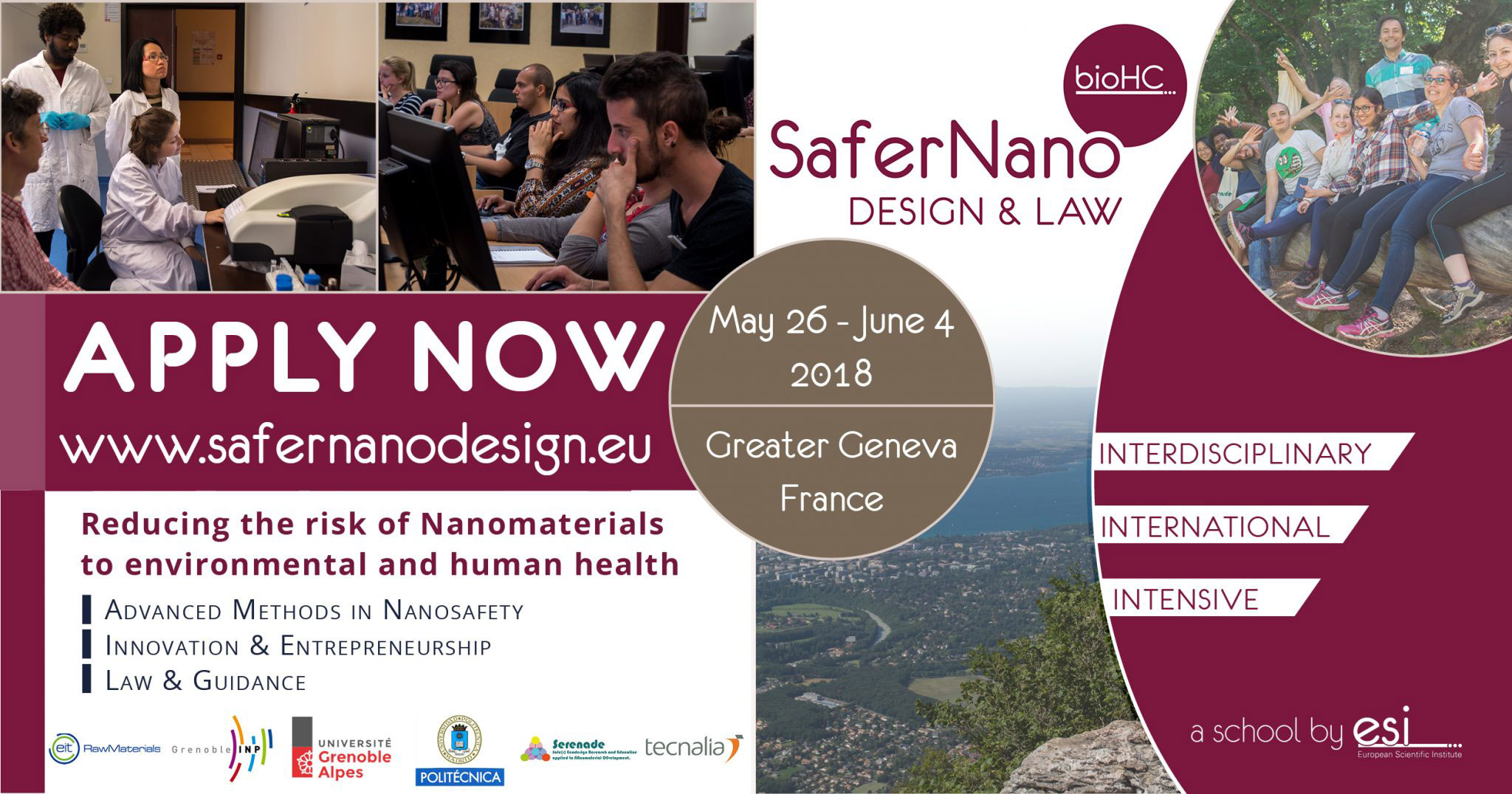
SaferNanoDesign: Summer School on Safer Design for Nanomaterials

Project duration: 1 January 2018 – 31 December 2020

SaferNanoDesign pioneers novel graduate education and research paradigms for the advancement of the nanotechnology transition.

Objective

Educating current and future entrepreneurs, material engineers, health professionals and scientific leaders in critical raw materials reduction and substitution and safe-by-design products.

The solution (technology)

A problem-based pedagogic approach is used in SaferNanoDesign, combined with teamwork to use the knowledge and skill each participant in the team. Scientist and startupers will meet the students, to discuss ideas with highly qualified professors and young entrepreneurs. They will explore together the different aspects of venturing and starting a company by visiting innovation labs and incubators. An introduction to Creative Thinking will be given, after which students will pitch business ideas in front of a panel of experts.

Partnership

  • Université Grenoble Alpes, France (Lead Partner)
  • Institut polytechnique de Grenoble (Grenoble Institute of Technology, INP), France
  • TECNALIA Ventures, Italy
  • Universidad Politecnica de Madrid, UPM (Technical University of Madrid), Spain

For more information about the SaferNanoDesign Summer School, please click here.

Mineral Processing/Resource Efficiency

SAMEX: Selective AMmoniacal Extraction Process for valorising Zn-rich BOF Sludges

Project duration: 1 January 2020 – 31 December 2022

Objective

In the EU AM generates 350 kt/y fine, Zn-rich BOF sludge, which requires storage or landfilling. In 2017-18 AM developed a process that selectively extracts Zn, leaving behind an Fe-rich residue that is internally recycled. In SAMEX, AM, TEC & KUL will upscale this process. A pilot plant is built to validate the process (TRL7). If successful, AM shall implement it in >1/3 of its EU-plants by 2025, while other sludge producers can also benefit.

The solution (technology)

For each million tonne of steel ArcelorMittal (AM) produces, it also generates on average 10,000 tonne of zinc-rich, fine Basic Oxygen Furnace (BOF) steelmaking sludge. In contrast with the coarse BOF sludge fraction, which is already internally recycled by AM via the sinter plant and then to the Blast Furnace, the fine BOF sludge fraction cannot be fed to the Blast Furnace (BF), as the zinc content would lead to prohibitive refractory failure and disturbances in the BF process. As a result, AM either internally stores these sludges or is forced to landfill them at future costs of 60 €/t (on a dry basis). To avoid excessive landfilling costs and to create an industrial symbiosis system, AM developed in 2017-2018 an ammoniacal leaching process, in collaboration with KU Leuven, first on lab-scale, subsequently on a small pilot level (TRL5). The developed process selectively extracts zinc from the sludge (76% leaching yield) while leaving behind most iron. The cleaned, iron-rich residue can be fed to the BF, representing major iron cost savings, while the leached zinc in the pregnant leach solution can be recovered as a zinc sulphide-precipitate product, as a feed for the zinc industry. In the SAMEX project, a knowledge triangle consortium – consisting of Tecnalia (ES, CLC South), AM (ES, CLC South) and KU Leuven (BE, CLC West) – shall upscale the AM process to TRL7, aiming to engineer and build a pilot plant, which will consist of several units: (a) dewatering (incl. filter pressing), (b) leaching reactor incl. air injection, (c) solid/liquid (filter press) separation, (d) ZnS precipitation). The lixiviants will be regenerated. The pilot plant will be used to demonstrate and validate the flowsheet, using distinct BOF sludges from different AM plants in Europe. If suc-cessful, AM foresees to implement the process in at least one third of its EU-plants by 2025 (i.e. treatment of 120,000 tonne/year BOF fine sludge). Furthermore, other sludge producers and steelmaking companies will be able to benefit from the results generated in the project.

Partnership

  • EIT Raw Materials GmbH, Germany
  • ArcelorMittal Innovación, Investigación e Inversión, S.L., Spain
  • Katholieke Universiteit te Leuven (KU Leuven), Belgium
  • TECNALIA Research & Innovation (Lead Partner), Spain
Mineral Processing/Resource Efficiency

SAMOA: Sustainable Aluminium additive Manufacturing for high performance Applications

Project duration: 1 April 2019 – 31 March 2022

Objective

3D printing of metals, specifically known as Additive Manufacturing (AM), gained growing importance in the industry during recent years. AM is a technology based on the rapid melting of the metallic powder or wire feedstock and its solidification, layer by layer, into the desired forms. Heat sources used in AM processes can be electron beams, arcs or laser beams. Parts that cannot be produced with conventional methods, such as with complex shapes or lattice structures, are possible to be manufactured by AM. The spherical powders necessary for some AM processes require complex processes to be manufactured and handled. Especially the market for aluminium alloys still offers no powders specifically designed for AM (considering, for example, chemical composition) and the desired end product properties. In addition, aluminium powder for AM on the market contains high raw material Si content and is expensive.

The solution (technology)

The proposed SAMOA upscaling project aims to provide a technological basis for the efficient and sustainable use of the raw aluminium material in the whole process chain of AM. This includes an efficient design of chemical composition of high strength alloys, efficient production of standard and tailored powders, and energy- and material-efficient processing covering all relevant AM-methods (SLM, DMD, arc-wire). This holistic approach will cut costs, will reduce European dependence on CRM and boost the EU producers’ competitiveness. Focusses will be on the careful use and efficient reuse of aluminium alloys, on improving the sustainability of the powder usage during processing chains and on the recyclability of the materials up to a high technological readiness level. The reduction of Si in the developed aluminium alloy along with the increased strength of the product (reducing material needs) will lead to a cut of the production costs and a reduction of the use of materials that are considered as critical for the EU.

Partnership

  • Luleå University of Technology (LTU), Sweden (Lead Partner)
  • Centro Ricerche Fiat S.C.p.A. (CRF – C.R.F.), Italy
  • Fraunhofer-Gesellschaft zur Förderung der angewandten Forschung e.V. (Fraunhofer), Germany
  • Gemmate Technologies, Italy
  • IMR Metal Powder Technologies GmbH, Austria
  • LTU Business AB, Sweden
  • Politecnico di Milano, Italy
  • Siemens AG, Germany