EIT RawMaterials Projects

The ambitious vision of EIT RawMaterials is realised by the creation of a structured collaboration within the Knowledge Triangle, which is the basis of the EIT model.

Call for Innovation & Education Projects is now open!

Learn more

EIT RawMaterials Projects Timeline

392 Projects
Project Portfolio
Innovation Themes
Innovation Areas/Lighthouses

Circular Economy

InSysHub: Industrial Symbiosis Hub

Project duration: 1 January 2020 – 31 December 2021

Objective

This Industrial Symbiosis Hub is set up to stimulate industries to bring their challenges on closing material loops to universities as assignments.

The solution (technology)

The hub organises events to introduce industrial symbiosis and discuss challenges with students, industries and university staff.

Partnership

  • Technische Universiteit Delft (Delft University of Technology), The Netherlands (Lead Partner)
  • ResourceFull BVBA, Belgium
  • Mineral and Energy Economy Research Institute of the Polish Academy of Sciences (MEERI), Poland
  • Leiden University, The Netherlands
  • Lappeenranta-Lahti University of Technology, Finland
  • Ghent University, Belgium
  • Coolrec, Belgium
  • Circularise, The Netherlands

For more information, please visit the project web page.

Circular Economy

intCEB: International Intelligence and Business Development Network on Circular Economy Business Opportunities with China
Project duration: 4 April 2017 – 31 December 2018

Objective

This project aims to lay the groundwork for an exchange network and export platform for innovative circular economy business model design, with internationalisation activities particularly focused on China. We will do so via integrating best knowledge and practices by the consortium, which brings together partners from EIT RawMaterials highly experienced on economic/environmental models (e.g. multi-regional metabolisms analytical tools and database), circular business design and governance innovation, and best regional implementation practices. Combining with our circular economy projects in China and already existing network with China’s stakeholders, we further aim to create an EU-China communication platform that can further enhance the collaboration on circular economy initiatives with a better understanding of circular economy business models.

Via the expertise of EIT RawMaterials, resource-efficiency and circularity give the potential of cost reductions in industry, which forms the basis for EIT RawMaterials to generate revenues. TNO estimate such cost reduction potential for the Netherlands at 7 billion Euro alone, and estimates at a global level range in the 100s of billions (Ellen MacArthur Foundation, 2012). China, being the biggest manufacturing economy globally, forms a major share of this. As indicated in the call, the 2016 call for internationalisation seeks explorative projects that identify opportunities. That is exactly what this project aims at. By gathering the strongest EIT RawMaterials partners and creating networks with Chinese counterparts, we are quite sure to get a good insight into the potential business opportunities for the EIT RawMaterials. These then can be worked out in concrete revenue generating business models and approaches in a follow-up internationalisation call that goes beyond inventory and exploration. Finally, with this consortium and network, we expect that we can already incubate follow-up projects both in EU and China paid by non-KIC sources, particularly since China is just in the beginning year of its 13th five-year economic development plan, we expect there are various opportunities for follow-up projects.

The solution (technology)

The whole network is expected to share knowledge and create business opportunities bilaterally so as to help circular economy practitioners to promote the optimal resource efficiency options. Based on the established intelligence network and communication with China’s partners, this project will promote synergies with the various actions that the EU Commission plans to implement with non-EU partners from 2015 onwards on raw materials, and provide an innovation agenda on future EU-China CEB collaboration, and bring business opportunities for EIT RawMaterials through enhancing circular economy in China’s local market. There is a genuine potential for creating business opportunities for KIC partners, by developing joint projects with Chinese partners that enhance resource efficiency and circularity and in this way reduce costs. With the collaboration of network, it is also expected to export EU and KIC’s products and business to Chinese circular economy market (software, databases, recycling technologies and products). From a financial sustainability perspective, the intelligence network constructed by this project and the knowledge contribution to innovative business model development for services with regard to circularity and resource-efficiency will, in the end, provide opportunities for EIT RawMaterials to create business value and revenues.

Partnership

  • Leiden University, The Netherlands (Lead Partner)
  • Fundación Tecnalia Research & Innovation, Spain
  • Ghent University, Belgium
  • Kungliga Tekniska Högskolan, KTH (Royal Institute of Technology), Sweden
  • National Technical University of Athens, Greece
  • Technische Universiteit Delft (Delft University of Technology), The Netherlands
  • Université de Bordeaux, France
Exploration

InvestRM: Multifactor model for investments in the raw material sector

Project duration: 1 January 2018 – 31 March 2021

Objective

After a decade of declining commodity prices, negative investment trends debated mining legislation and increased overall risks, mining companies are struggling to survive searching for new sustainable investment options.

The InvestRM project will create a decision-making tool for raw materials companies and investors, mining institutes, technical universities, geological surveys, non-governmental association, the Bosnia and Herzegovina government and state institutions in order to facilitate investment in the raw material sector. The project is focused on Bosnia and Herzegovina due to its critical raw materials potential but will be fully transferable to other East and Southeast European (ESEE) countries.

The solution (technology)

The InvestRM project aims to design an online accessible, decision-making tool for facilitating investment in the raw material sector. The tool will contain relevant, updated and RM-tailored country data (legal, social, economic), together with verified critical raw materials database.

The project will deliver structured country data (entity-based) together with relevant and validated geo-information on 120 critical raw materials deposits and occurrences within Bosnia and Herzegovina: antimony, bauxite (as a potential source of rare earth elements – REE), fluorite and magnesite. One of the special tasks is the establishment of a constructive dialogue with minimum 40 SMEs and large companies throughout Banja Luka, Prijedor, Tuzla and Zenica, info-days in order to tailor the InvestRM decision-making tool.

Partnership

  • University of Zagreb – Faculty of Mining, Geology and Petroleum Engineering (UNIZG-RGNF), Croatia
  • Cemex Croatia, Croatia
  • Geological Survey of Slovenia (GeoZS), Slovenia
  • Institute for urbanism, civil engineering and ecology, Bosnia and Herzegovina
  • Mining Institute Banja Luka, Bosnia and Herzegovina
  • Mining Institute Prijedor, Bosnia and Herzegovina
  • Mining Institute Tuzla, Bosnia and Herzegovina
  • Montanuniversität Leoben, Austria
  • University of Zenica, Metallurgical Institute, Bosnia and Herzegovina
Sustainable Mining

iRIS – intelligent Risk Identification System for safer mines
Project duration: 1 April 2016 – 31 December 2018

Objective

The project aims to reduce the number of vehicle fires with 20% and minimize standstill due to vehicle fires, by analysing results from earlier inspections, incidents and fires and automatically integrating the knowledge into future inspections.

The solution (technology)

The solution is a digital system which consists of two parts – an inspection tool and a knowledge-based research database, allowing experiences from earlier inspections, research project results, occurred incidents and fires and fire safety information from manufacturers to be used as input back to the inspection tool.

Partnership

Mineral Processing/Resource Efficiency

IRTC: International Round Table on Materials Criticality

Project duration: 1 January 2018 – 31 March 2020 

Objective

Critical raw materials are materials which we need for current and future products and technologies, but which are now or soon difficult to acquire. This can be for a variety of reasons: e.g. because they are scarce in the Earth’s crust, as they are only available in specific regions, their price is so volatile that there are periods when they are unaffordable, or because of their mining and processing cause environmental or social problems. These materials often have special properties that make them important for modern applications such as electronics or new energy technologies.

IRTC is an international network of experts in critical raw materials who work on definitions and assessments on which materials are or will be critical in the future. Since „criticality“ depends on the perspective – e.g. how scarce a material is in one’s own region, or how much of it is needed in an economy or a technological sector – these approaches differ.

The solution (technology)

The project will establish an international roundtable on approaches towards assessing materials criticality, taking place at established international conferences, creating synergies between different audiences such as experts in resource planning, industrial ecology, Life Cycle Assessment, and product development. The results will be published as three joint scientific papers for an expert audience and a Roadmap on Criticality for authorities.

IRTC will also educate junior researchers, engage with industry and advice authorities on how to integrate the topic into strategies and policies on a national and global level. Its final goal is a long-lasting international collaboration.

Partnership

  • ESM Foundation, Switzerland (Lead Partner)
  • The French geological survey (BRGM), France
  • Chinese Academy of Sciences, China
  • Colorado School of Mines, USA
  • Critical Materials Institute, US Department of Energy, USA
  • Empa Materials Science and Technology, Switzerland
  • Fraunhofer-Gesellschaft zur Förderung der angewandten Forschung e.V., Germany
  • Ghent University, Belgium
  • Joint Research Centre of the European Commission, Directorate D: Sustainable Resources (JRC), Italy
  • Korea Institute of Industrial Technology KITECH, Korea
  • Leiden University, Netherlands
  • Los Alamos Laboratory, USA
  • National Institute for Environmental Studies (NIES) Japan, Japan
  • Royal Melbourne Institute of Technology, Australia
  • Delft University of Technology, Netherlands
  • US Geological Survey (USGS), USA
  • Université de Bordeaux, France
  • University of Southern Denmark, Denmark
  • University of Waterloo – School of Environment, Enterprise and Development, Canada
  • University of York, United Kingdom
  • Yale University, USA

More information is available on the IRTC project website.

Substitution

IRTC-Business: International Round Table on Criticality in Business Practice

Project duration: 1 April 2020 – 31 March 2022

Objective

IRTC-Business continues and implements the work of IRTC, an international expert group on criticality. The project will conduct Round Tables and publish their outcomes, with the goal to apply the concepts to company use. It will support industry in assessing its exposure to criticality issues and support decision-making, as well as identifying mitigation measures. A web-based tool developed by the project will support these actions.

The solution (technology)

Critical raw materials are materials that are needed for current and future products and technologies, but face now or soon a significant risk of not being sufficiently available. This can occur for a variety of reasons: e.g., because the materials are scarce in the Earth’s crust, because they are only available in specific regions, because their price is so volatile that there are periods when they are unaffordable, or because their mining and processing cause environmental or social problems. These materials often have special properties that make them important for modern applications such as electronics or new energy technologies.
IRTC-Business is an international network of experts in critical raw materials who work on definitions and assessments regarding which materials are or will be critical in the future. Because „criticality“ depends on the perspective – e.g., how scarce a material is in one’s own region, or how much of it is needed in an economy or a technological sector – these approaches differ, and industries often do not know in which regard criticality might affect their company. IRTC-Business organizes international expert meetings and publishes guidance documents on this topic and will support companies in knowing more about which materials are critical for them, and how they can manage their use of these materials.

Partnership

  • The French Geological Survey, France
  • EMPA – Swiss Federal Laboratories for Materials Science and Technology, Switzerland
  • Fraunhofer-Gesellschaft zur Förderung der angewandten Forschung e.V. (Fraunhofer), Germany
  • Ghent University, Belgium
  • Granta Design Limited, United Kingdom
  • Leiden University, Netherlands
  • Netherlands Organisation for Applied Scientific Research, Netherlands
  • Delft University of Technology, Netherlands
  • Université de Bordeaux, France
  • ESM Foundation (Entwicklungsfonds Seltene Metalle – Foundation for Rare Metals) (Lead Partner), Switzerland
Exploration

iTARG3T: Innovative targeting & processing of W-Sn-Ta-Li ores: towards EU’s self-supply

Project duration: 1 January 2019 – 31 December 2021

Objective

One of the wealthiest tungsten-tin-(tantalum-lithium) mineral belts in the world is located in western and central-eastern Europe, where different types of mineralization are related to certain granitic rocks. These ore deposits were intensely mined till the 1980s when the global crash of metal prices triggered the closure of most of the tin mines. More recently, market and political changes in the 2010s initiated the gradual reactivation of this mining sector and currently, there are a few producing mines and tens of advanced exploration projects. However, all of these projects are brownfields and occur in or near already existing mine sites. This is partially caused by several issues that are specific for this type of mineralization. The deposits are usually low tonnage and mostly worked by SME’s, they form irregular masses or narrow veins with difficult grade control, resource evaluation, and ore processing. Furthermore, the restricted geographic location, away from the major ore belts, and the price crisis have kept these deposits away from the recent advances of conceptual exploration. All of these problems have hampered greenfields exploration and advances in ore concentration and resource estimation.

The solution (technology)

This project aims to solve most of the problems that arise during the early and advanced stages of W-Sn-(Ta-Li) exploration, effective ore targeting, and ore processing. It is estimated that using the methods proposed, around ten new mines can be developed and opened, reaching the European self-production on a mid-term time scale. The technical work packages of this project are designed to solve specific problems related to the targeting of the most economically significant styles of W-Sn-(Ta-Li) mineralization. This is predicted to promote the interest of junior companies for these targets, giving guides for exploration and solving many of the technical problems that arise during the ‘Go or No-Go’ decisions in mineral exploration. The proposed work includes the evaluation and definition of the key guides for ore exploration (conceptual modelling and definition of pathfinders and vectors to ore, including magnetic anomaly and trace element/mineralogical variations in hydrothermal aureoles, structural studies and geophysical exploration), the evaluation of mineralogical and petrophysical properties of these complex ores using a novel and efficient, water- and energy-saving prototype for comminution (VeRo Liberator®), a new method of grade and resource evaluation using digital discrimination of ores, as well as modern approaches to obtaining the social license for mining.

Partnership

  • Agencia Estatal Consejo Superior de Investigaciones Cientificas M.P., CSIC (Spanish National Research Council), Spain (Lead Partner)
  • AGH University of Science and Technology, Poland
  • Fakulta Geologie Narodnej Univerzity Tarasa Szevczenka v Kijeve (University of Kiev), Ukraine
  • Geomet s.r.o., Czech Republic
  • Lithica SCCL, Spain
  • LuleÃ¥ University of Technology (LTU), Sweden
  • Martin Luther Universität Halle-Wittenberg, Germany
  • Mineral and Energy Economy Research Institute of the Polish Academy of Sciences (MEERI), Poland
  • Redstone Exploration Services Sp. z o.o., Poland
  • Sociedade Mineira de Pegmatites Ltda (Pegmatítica), Portugal
  • Universidad Politecnica de Madrid, UPM (Technical University of Madrid), Spain
  • University of Zagreb – Faculty of Mining, Geology and Petroleum Engineering (UNIZG-RGNF), Croatia
  • Valoriza Minería SLU, Spain

LAYTERM: Layman courses for the Transfer of Expertise on Raw Materials

Objective

Layman courses for the Transfer of Expertise on Raw Materials (LAYTERM), will develop and disseminate a suite of short courses on mineral raw material production for laypersons, such as policy makers, government employees, and representatives from NGOs etc.

The course topic areas shall comprise different segments of the production chain or the mine life cycle, respectively:

  • mine project development,
  • mining, minerals and metallurgical processing (incl. metal recycling) and
  • environmental issues of mining and metallurgy.

Potential courses that can be derived out of these topic areas could emphasise:

  1. The economic importance of mineral raw materials for Europe
  2. Mineral exploration and mining project development
  3. Mining and mineral production
  4. Metallurgical production and metal recycling, life cycle of metals
  5. Environmental issues of mining

The teaching concepts will involve face-to-face learning as well as e-learning methods.

The solution (technology)

The suite of courses is expected to contribute to raising awareness and acceptance of the mineral raw material sector, and is designed to fill the knowledge gaps in production technology by conveying general awareness of existing technical constraints with regard to both raw material and process technology. Interdependencies occurring between individual processing steps make it usually necessary to take a more holistic view on the entire value chain of minerals and metallurgical production, in order to give layman persons a better insight into technical alternatives and their constraints.

Partnership

  • LuleÃ¥ University of Technology, Sweden (Lead Partner)
  • Chalmers University of Technology, Sweden
  • DMT GmbH & Co. KG, Germany
  • Montanuniversität Leoben, Austria

Programme Co-ordinator: Prof. Jan Rosenkranz, Luleå University of Technology, jan.rosenkranz@ltu.se

LEGO: Listening to Enterprises to Get Opportunities
Objective

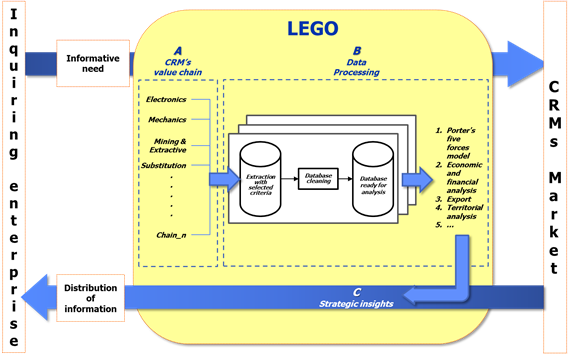
The main objective of LEGO service is to offer specific, detailed analysis for local requests that will be investigated from time to time in order to support enterprises in their decision-making process. The scope of LEGO includes the support of enterprises in their strategic planning and decision making, through the identification and analysis of different CRMs chains, collection and analysis of the data related to CRMs issues, providing of infographic and report of analysed data and identification of business opportunities with strategic insights.

The solution (technology)

LEGO intends to boost the competitiveness of the enterprises operating in the raw materials industry, providing an on-demand decision-making support service to understand the competitive dynamics of the market and find out new business opportunities. The analytical tool will have an impact on the capacity of enterprises to make decisions and implement their corporate and business strategies, expanding their business also beyond their existing local or regional reach. The database, containing data on the enterprises of all Europe, will also enable the enterprises to expand their activities at international level and match with complementary stakeholders. In this way, LEGO will contribute, in the long term, to strengthen the competitiveness of industries across Europe and increase employment and economic growth.

Partnership

  • Milano Bicocca University, Italy (Lead Partner)
  • Mineral and Energy Economy Research Institute of the Polish Academy of Sciences, Poland
  • Zanardi Fonderie S.p.A, Italy